Uptime · heartbeats · SSL · domains
Know when it’s down. Sleep through the rest.
We watch your sites, servers and scheduled jobs around the clock. A real outage reaches your phone in seconds. A blip does not reach you at all.

Create the account here or in the app · Requires iOS 18 or later · Android coming soon
2 failed checks in a row — that is an outage
incident opened · connection refused · alert sent
1 monitor is down
1 open incident across 6 monitors.
Open incidents
1- DownAcme API
Connection refused · failing in Northern Virginia
Open for 30sLast seen up 2 minutes ago
Recently changed
- Acme APIDownLast seen up 2 minutes agojust now
- Acme storefrontUpUp for 2 days2 days ago
How it works
A 3am outage, minute by minute.
This is the night the panel above is playing: one site, checked every thirty seconds, called down after 2 failures in a row. That is the default, and it is why a single hiccup never costs you a night’s sleep.
03:12:04
A check fails.
UpNothing happens. One refused connection is not an outage, and this monitor waits for 2 in a row. The result is saved either way.
03:12:34
The next one fails too.
DownNow it counts. An incident opens with what failed, where it was checked from, and when the site was last healthy.
03:12:35
Your phone lights up.
Everyone on the team gets a push, and a live countdown appears on the lock screen. Tap to acknowledge. If nobody does, it escalates — another push, then a phone call.
03:20:34
It comes back.
UpThe site answers again and the incident closes with the total downtime: 8m. The chart keeps the gap where the failed checks were.
09:00:00
You read about it over coffee.
Every check for thirty days, uptime across ninety, hourly summaries kept forever. Nobody had to be awake for any of it.
What you can watch
Six things we check. One that checks in with us.
- HTTPLoads your page or API and checks the status, headers and contentA bad deploy, a 500, a response that quietly changed
- TCPOpens a connection to a portA service that died without taking the server with it
- PingPings the hostA machine that dropped off the network
- DNSLooks up your records and compares them to what they should beA DNS change nobody told you about
- SSLReads the certificate and counts the days leftAn expiry, weeks before your visitors see the warning
- DomainReads the registration straight from the registryThe renewal everyone assumed somebody else had handled
- HeartbeatNothing — your job checks in with usA backup or cron job that quietly stopped running
Silence is the signal.
Add one line to a job you already run. If it does not check in on time, that is an incident, and it reaches you like any other.
0 4 * * * /usr/local/bin/backup.sh && curl -fsS https://lastseenup.com/hb/kQ3nR8vBx2mL7pD4wF6tYc9sThat URL always answers OK — even for a link it has never seen, or on a bad day at our end. A monitoring service that returns an error into your cron job is a monitoring service that breaks your cron job.
No false alarms
Alerts you can actually trust.
A monitoring tool that cries wolf gets deleted faster than one that misses an outage. So most of the work went into what it will not do.
It won’t wake you because something got slow.
Degraded shows on your dashboard and on the chart. Only going down sends an alert.
It won’t send twelve alerts for one bad night.
A monitor bouncing up and down is marked as flapping, and the noise collapses into a single notification until things settle.
It won’t alert during your own deploy.
Set a maintenance window and the alerts pause. The record does not — you still get the full history.
It won’t invent an outage.
If we can’t trust our own data, nothing opens. Missing a real outage by a minute beats inventing one at 3am.
Where it reaches you
The alert finds you. The dashboard is for the morning after.
The iOS app is where an outage actually reaches you. It is not a viewer for the website — it pages you, and you can shut the escalation down from the lock screen.
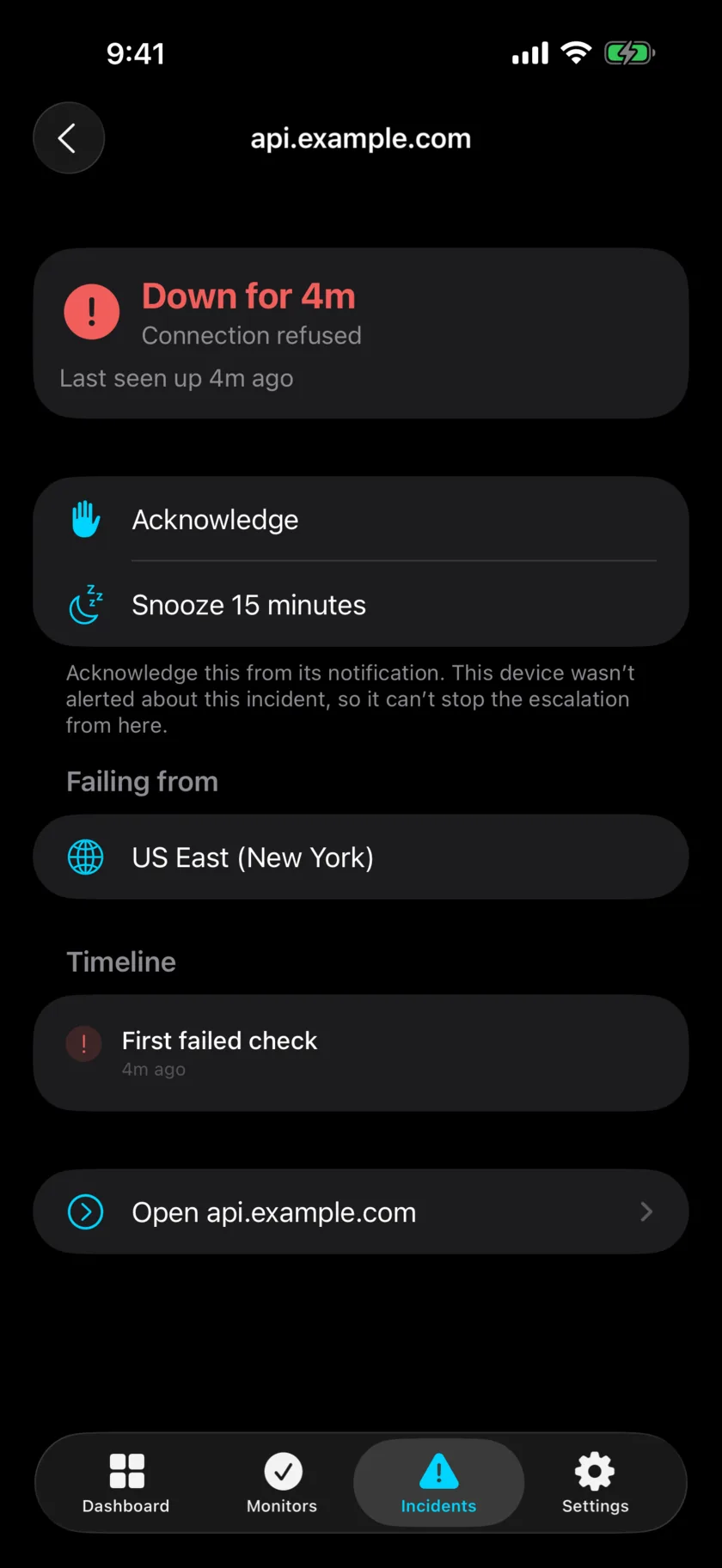
The alert
Acknowledge in one tap, without unlocking.
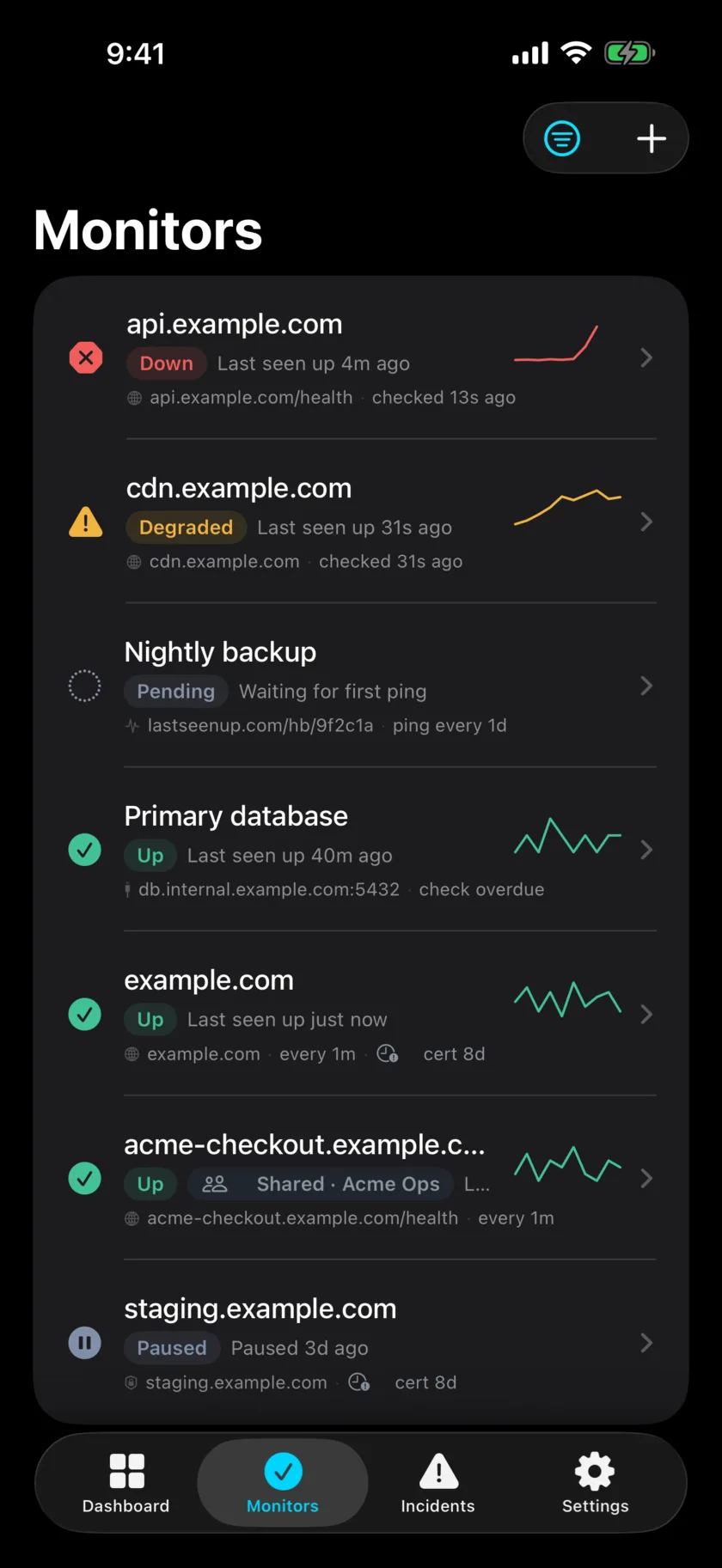
Your monitors
Everything you watch, and what it is doing now.
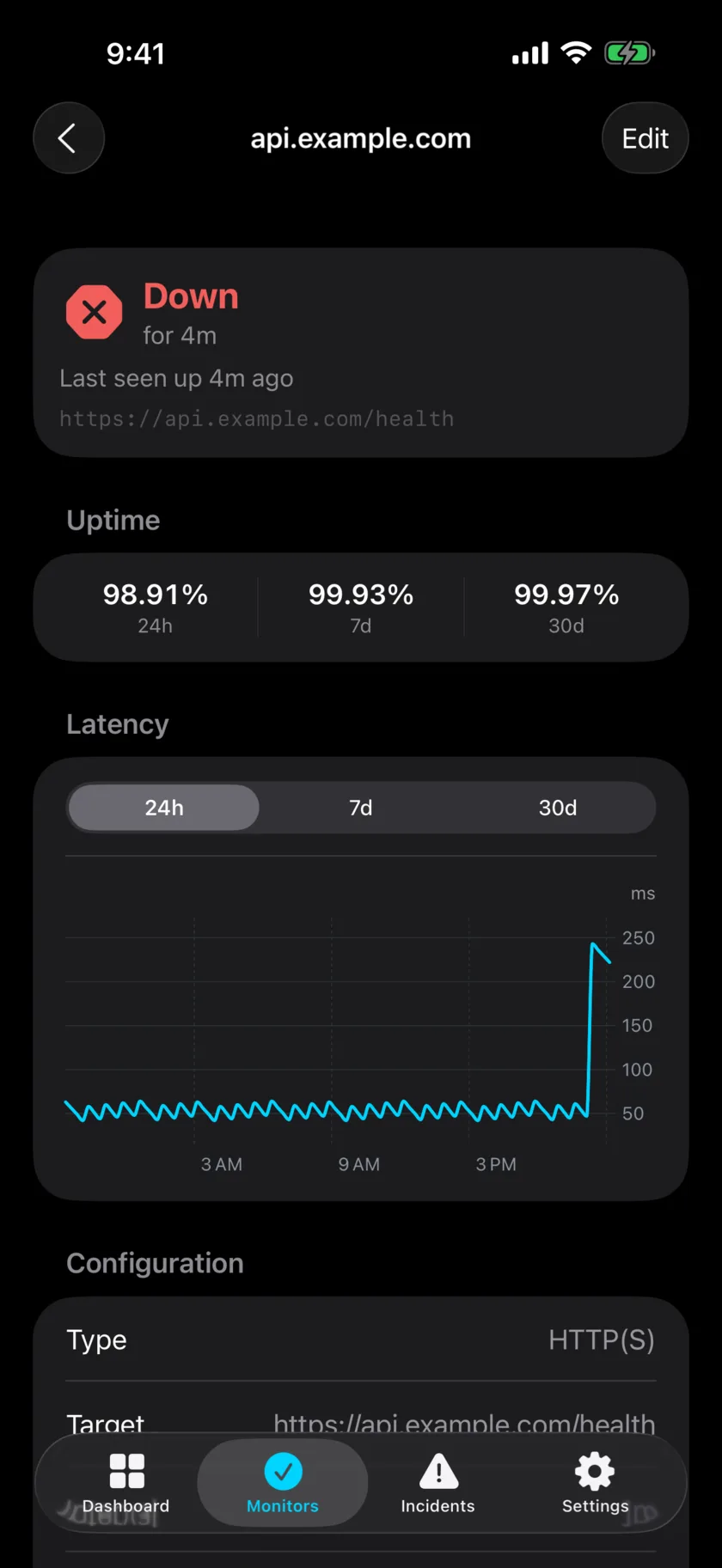
One monitor
Uptime and latency, back thirty days.
On your phone
- A push the moment a monitor goes down
- A live countdown on your lock screen
- Acknowledge in one tap, without unlocking
- A phone call if the push goes unanswered
- Sign in with Apple, a magic link, or a password
Requires iOS 18 or later · free with every plan
In your browser
- Every individual check, back thirty days
- Uptime across the last ninety days
- Each incident, its timeline, and who acknowledged it
- Updates itself as monitors change — no refresh
HTTP · TCP · Ping · DNS · SSL · Domain · Heartbeat
Android
The Android app is coming. The beta needs testers.
Same monitors, same team, same push the moment something goes down. Leave your email and we will send you a Play Store invite the day the closed beta opens.
Featured on


Tell us what is missing over there. It is the quickest way to say it in public.
Plans
Start free. Pay when you outgrow it.
Every check type, every alert, Live Activities, the widgets and the watch app are on both. What a subscription buys is room.
Free
Free
- 3 monitors
- 1 person
Pro
$5.99a month
or $59.99 a year
- 50 monitors
- 10 people
Buy it here or in the iOS app — you are billed once either way. Cancel whenever you like; you keep the plan until the period you paid for runs out, and dropping back to Free never deletes a monitor.
Start with one monitor.
Add a URL, choose how often to check it, and add your phone. You will hear from us the next time it actually matters — and not before.
The app creates and signs into the same account · Requires iOS 18 or later · Android coming soon